Energy tokenisation
A digital prototype to explore how blockchain traceability, tokenisation and gamification could be applied to a real-world energy community.
The project was based on data from a real-world energy community, which had been pre-processed by the energy supplier, and sought to adapt an existing blockchain traceability service to a new context: that of shared energy, surplus energy, and the involvement of prosumers and consumers. My involvement focused on managing the delivery and designing the gamification layer, helping to define the scope of the prototype, translate complex concepts into a more understandable experience, and explore how the participation of different profiles within a small energy community could be visualised.
Energy · Traceability · Tokenisation · Energy communities · Delivery
The problem
The challenge of measuring and auditing energy exchange within a small energy community, exploring how blockchain traceability and tokenisation could help to represent the flows between prosumers and consumers more transparently.
Energy communities offer a more participatory and decentralised model of production and consumption, but how they work can be difficult for users to understand. Concepts such as surplus energy, energy sharing, traceability, balances and tokenisation do not always translate clearly into a straightforward digital experience.
In this case, the challenge was to investigate how a small energy community could benefit from mechanisms for tracking and digitally representing its activity, given a significant constraint: the data was already being processed by the energy supplier, so the potential for the solution to add value had to be assessed realistically.
Measurement of energy exchange
In an energy community, production, consumption and surpluses generate data flows that are difficult to interpret unless they are clearly visualised. The challenge was to explore how to measure this exchange between prosumers and consumers and turn it into useful information within a digital experience.
Auditing and data reliability
Traceability could have added a layer of trust to the shared energy scheme, but the project was based on data that had already been processed by the energy supplier. This made it necessary to realistically assess which part of the process could be audited and where a blockchain-based solution could add value.
Meaningful participation
For an energy community to function effectively, users need to understand their role within the system. The challenge was not simply to present data, but to design an experience that would make the individual and collective participation of consumers and prosumers easier to understand.
The solution
Decentralised traceability
A blockchain-based traceability service was developed to record information relating to energy production, consumption and surpluses within an energy community. This decentralised layer served to enhance the transparency of energy exchange and explore how to audit shared activity across different user profiles. The aim was to ensure that energy flows were not merely aggregated data or internal records, but could be represented in a way that was traceable, verifiable and linked to the community’s actual activity.
Energy tokenisation
The solution incorporated a tokenisation layer to digitally represent the energy exchanged between consumers and prosumers. Using the available data, the shared energy could be converted into traceable digital units, providing a clearer picture of the balances, flows and relationships within the energy community.
This tokenisation helped to transform a technical process—production, consumption, surpluses and exchange—into a framework that was easier to understand from the product’s perspective, highlighting what was happening within the community and how its various members were involved.
Gamified UX
A gamification layer was designed to make participation in the energy community more accessible and engaging. The proposal explored ways of presenting activity, progress, impact and contributions in a more visual manner, bridging the gap between technical data and the user experience.
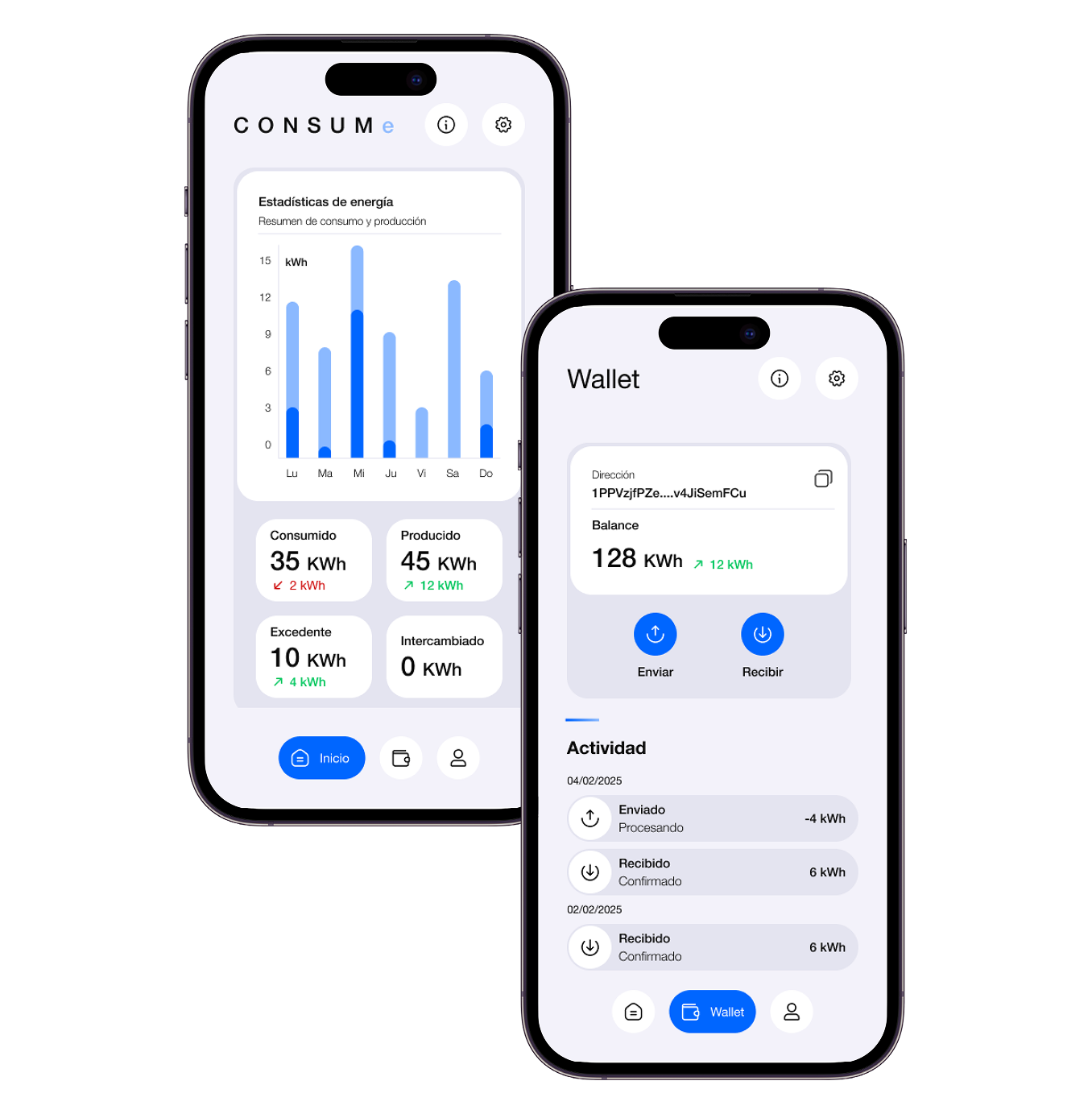
Energy tokenisation
Tokenisation made it possible to convert shared energy into traceable digital units, providing a clearer picture of the flow of energy between consumers and prosumers. This approach helped to present the energy exchange in a more understandable way, linking technical data on production, consumption and surpluses with a more visual and actionable product framework.
Community exchange
The gamification layer explored ways of making the exchange of tokens between members of the energy community more visible. Although this aspect was developed as a design and prototype, it allowed us to envisage a more accessible experience for consumers and prosumers, where participation, activities and contributions within the community could be understood more easily.
Prototype based on real data
Although the solution was never actually used by end users, the prototype operated using data from a real-world energy community. This made it possible to apply the use case to a realistic scenario, identify the model’s limitations, and assess more effectively the value that a blockchain layer could add to energy data that had already been processed.
Decentralised infrastructure
The project enabled the development of a decentralised layer for recording and auditing information relating to the production, consumption and surpluses of an energy community. The key lay in applying blockchain technology to a context where trust in the data and transparency of transactions were essential to the use case.
My role
Delivery management and design of the gamified UX
My role focused on managing the delivery of the prototype and designing the gamification layer linked to the exchange of tokens within the energy community. On the delivery side, I worked on scope tracking, functional coordination and ensuring alignment between the use case requirements, the available data and the technical solution developed. On the design side, I was involved in conceptualising a gamified experience for consumers and prosumers, aimed at making activity within the community more visible and representing the energy exchange between its members in a simple way.
Results
The project resulted in a prototype based on real-world data from an energy community, featuring a decentralised infrastructure for energy traceability and tokenisation, alongside a gamified experience designed to visualise the participation of consumers and prosumers. Although the solution was not ultimately adopted by end users, it enabled the team to explore how blockchain and tokenisation fit into a real-world energy context and to identify more clearly the limitations and opportunities of this use case.
Learning
This project highlighted the importance of carefully analysing where an emerging technology adds value. Blockchain traceability and tokenisation can help build trust and transparency, but their impact depends on the stage of the process at which they are applied, the quality of the available data, and the real-world utility they provide for users. It was also a valuable lesson in how to design prototypes with realistic scope, distinguishing between what has been developed, what has been validated, and what has been explored conceptually.
Let’s talk about traceability and emerging technologies
I design and develop digital products that translate complex systems—such as tokenisation, traceability and decentralised models—into clear, understandable experiences that address real-world needs.