Data centre services
AI, HL7 and verifiable credentials for sharing clinical data in a structured and reliable manner.
The project forms part of an R&D programme aimed at developing services integrated with healthcare data repositories. The proposal explored how to transform unstructured clinical information into interoperable data, how to share it using verifiable credentials, and how to enable artificial intelligence services that would help healthcare professionals to access, summarise and analyse clinical information more efficiently.
Unlike a centralised repository, the data space was conceived as a framework of trust for connecting systems that are not, by definition, integrated with one another. In this context, the project focused on synthetic data and a laboratory environment, with the aim of validating services capable of processing sensitive health information in accordance with rules governing consent, security and interoperability.
Health · Data spaces · Generative AI · HL7 · Verifiable credentials · Delivery
The problem
The challenge of facilitating the secure and interoperable exchange of health information between unconnected systems, enabling clinical data from different sources to be structured, verified and used to support clinical care or research processes within a framework of trust.
Healthcare systems often deal with information that is scattered across different organisations, formats and levels of quality. A patient may have part of their medical records at a public hospital, another part at a private clinic, and additional documentation in PDFs, scanned reports or unverifiable sources. This fragmentation makes it difficult for healthcare professionals to gain a comprehensive and structured overview of the clinical case.
Furthermore, health data is particularly sensitive. It is not enough simply to transfer information from one system to another: clear rules must be established regarding consent, security, verification, interoperability and subsequent use. In this context, data spaces offer a way of connecting organisations and services without turning the exchange into a centralised repository, but rather into a framework where data and services are accessed under controlled conditions.
Clinical interoperability
In order for the data to be useful within hospital systems or diagnostic support services, it had to be converted to healthcare standards such as HL7. The challenge lay in converting unstructured or partially structured information into data that other systems could understand.
Trust and consent
The exchange of clinical information required mechanisms to verify the origin of the data, manage patient consent and ensure that any subsequent use complied with the rules of the data space.
Diagnostic help regarding fragmented data
Healthcare professionals need quick access to relevant information: a summary of the patient’s medical history, test results, current treatments or key medical history. When data is scattered or poorly structured, finding this information takes time and can hinder decision-making.
The solution
Conversion of clinical data to HL7
One of the project’s services enabled the conversion of unstructured or semi-structured clinical information into data compatible with healthcare standards such as HL7. With the help of artificial intelligence, the service facilitated the extraction, structuring and standardisation of information from various clinical documents or sources, enabling hospital systems to integrate and utilise it more effectively.
Verifiable credentials for health data
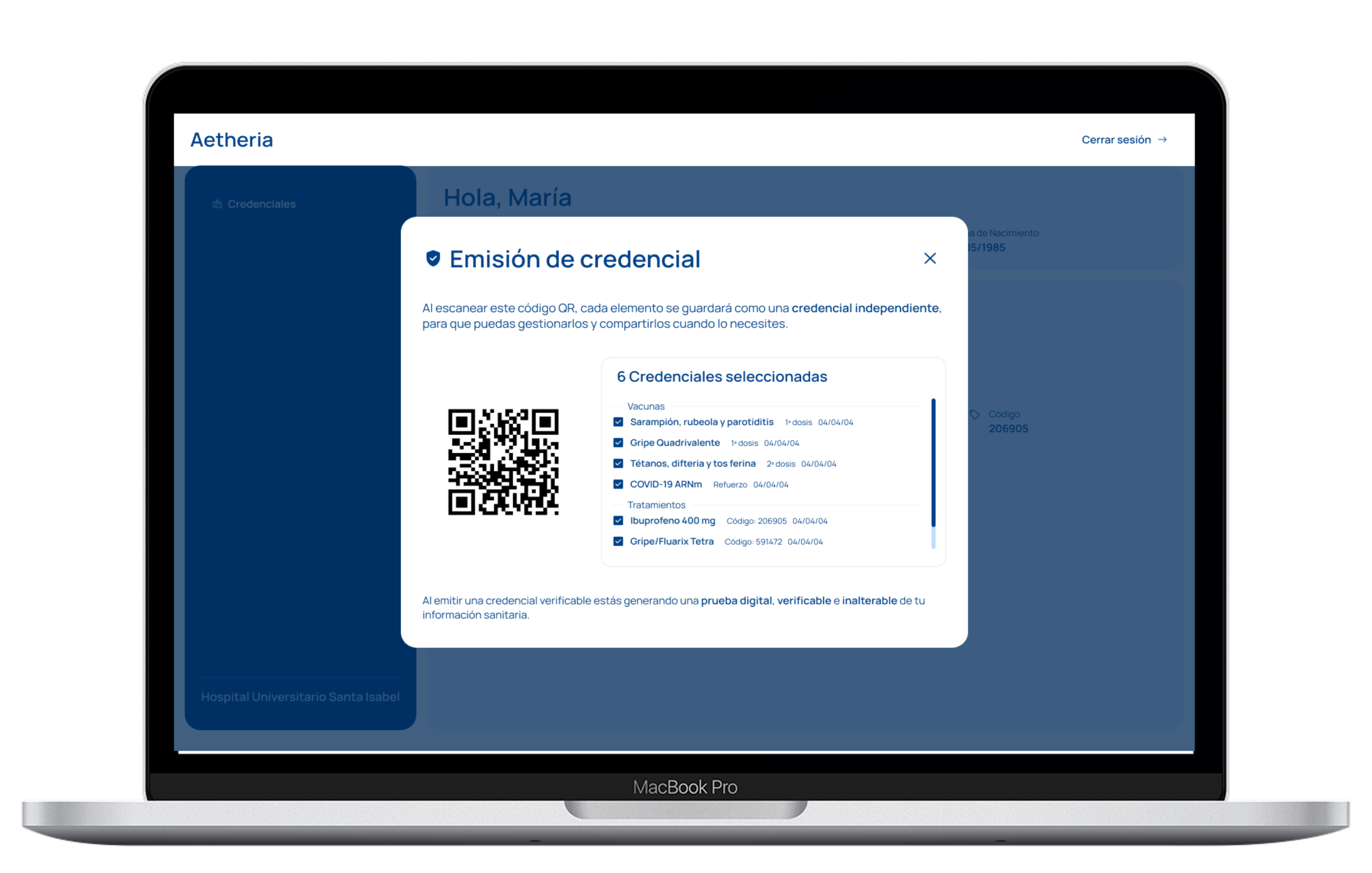
The project also explored the use of verifiable credentials to reliably represent and share clinical information. In one use case, a patient could request their data from a hospital, receive it as a credential, and subsequently present it at another healthcare facility. The receiving system could verify the credential, incorporate the information into its infrastructure and decide, with the patient’s consent, whether to use that data for care, research or access to other services within the data space.
AI agent for clinical consultation
El proyecto incluía un agente de inteligencia artificial generativa orientado a ayudar a profesionales sanitarios en la consulta de información clínica. A partir de los datos disponibles sobre un paciente en una sesión temporal, el agente podía responder preguntas sobre historial, parámetros analíticos, tratamientos actuales o información relevante para el diagnóstico, facilitando una lectura más rápida y ordenada del caso clínico.
Conversion to clinical standards
The transformation service enabled the conversion of unstructured or semi-structured clinical information into data compatible with healthcare standards such as HL7. This layer was key to ensuring that documents, reports or data from different sources could be integrated more effectively into hospital systems and services connected to the data space.
Verifiable healthcare credentials
The use of verifiable credentials made it possible to explore a model in which patients could carry and present some of their clinical information to other healthcare providers. This approach provided a layer of trust regarding the origin and integrity of the data, facilitating scenarios such as second opinions, continuity of care, or data exchange between public and private systems.
A trusted environment for exchange
The data space served as a framework for connecting systems, services and organisations that had not previously been integrated. Rather than simply storing information in a centralised repository, it enabled the definition of rules governing access, consent and usage, thereby facilitating the secure exchange of data and services within a sensitive healthcare context.
AI services for time-series data
The generative AI agent operated on a session-by-session basis, using the patient data available at that time to answer clinical questions, summarise information or identify relevant parameters. The aim was not to replace medical judgement, but to provide rapid access to scattered information and support decision-making.
My role
Delivery, functional definition and UX design
My role focused on managing and monitoring the project’s delivery, coordinating functional requirements, technical progress, documentation and dependencies within an ongoing R&D context. I worked on the functional definition of services, research, the roadmap, demo preparation, functional QA and UX design, linking the various use cases with an experience that was easy to understand for healthcare and technical professionals. Although the visual interface was developed by a member of the team, my role included defining workflows, requirements, screen structure and functional validation, ensuring that the services — data transformation, verifiable credentials and AI agent — responded consistently to the proposed use case.
Results
My role focused on managing and monitoring the project’s delivery, coordinating functional requirements, technical progress, documentation and dependencies within an ongoing R&D context. I worked on the functional definition of services, research, the roadmap, demo preparation, functional QA and UX design, linking the various use cases with an experience that was easy to understand for healthcare and technical professionals. Although the visual interface was developed by a member of the team, my role included defining workflows, requirements, screen structure and functional validation, ensuring that the services — data transformation, verifiable credentials and AI agent — responded consistently to the proposed use case.
Learning
This project reinforced my understanding of how to design and manage digital solutions in highly regulated sectors, where technical innovation must be balanced against security, consent, interoperability and ecosystem maturity. It also helped me to better understand the role of data spaces as frameworks of trust, rather than mere repositories, and to translate complex concepts — such as HL7, verifiable credentials, generative AI and temporary data consumption — into comprehensible workflows for a demonstrable product.
Let’s talk about data, AI and interoperability
I support digital projects that bring together emerging technologies, sensitive data and real business needs, helping to transform complex scenarios into clear, demonstrable and user-focused solutions.