Traceability Service
End-to-end traceability service for the wine industry based on blockchain and artificial intelligence
An innovation project aimed at improving the traceability of agri-food processes in the wine sector by connecting information from different sources, systems, and stages of the value chain. The solution combines data integration, blockchain-based tokenization, and the use of computer vision for recognizing physical product labels. My role focuses on coordinating implementation, ensuring functional deployment, and defining workflows, helping to organize complex processes involving multiple integrations, stakeholders, and heterogeneous information sources.
Industrial Traceability · AgroTech · Blockchain · Tokenization · Visual AI · Delivery
The problem
The challenge of digitizing a fragmented value chain, transforming it into a clear, immutable traceability system that is integrated with the day-to-day operations of wineries.
The project is based on an environment where information on production, processing, and product tracking is scattered across various processes, systems, and disparate data sources. The challenge lies in linking this data in a coherent manner, ensuring its reliability, and turning traceability into a useful tool for operations, quality control, and decision-making.
Processes involving scattered information
Wine traceability involves multiple stages, stakeholders, and data points throughout the value chain. The challenge lies in organizing this information—which comes from production processes, internal systems, and external sources—to build a more comprehensive, reliable, and accessible view of the product’s journey.
Evidence that is difficult to verify
In an industrial setting, simply recording data is not enough; it is also necessary to be able to trust its source, integrity, and evolution. The solution must facilitate the recording of verifiable evidence, reducing reliance on manual checks or isolated information and providing greater confidence in what happens at each stage of the process.
Operational and technological complexity
Data is not generated at a single point, but rather at different times, using different tools and processes. The challenge lies in connecting this operational reality with a system capable of organizing the data, interpreting the evidence, and providing a reliable view of the product’s journey without relying on isolated records.
The solution
App for consumers
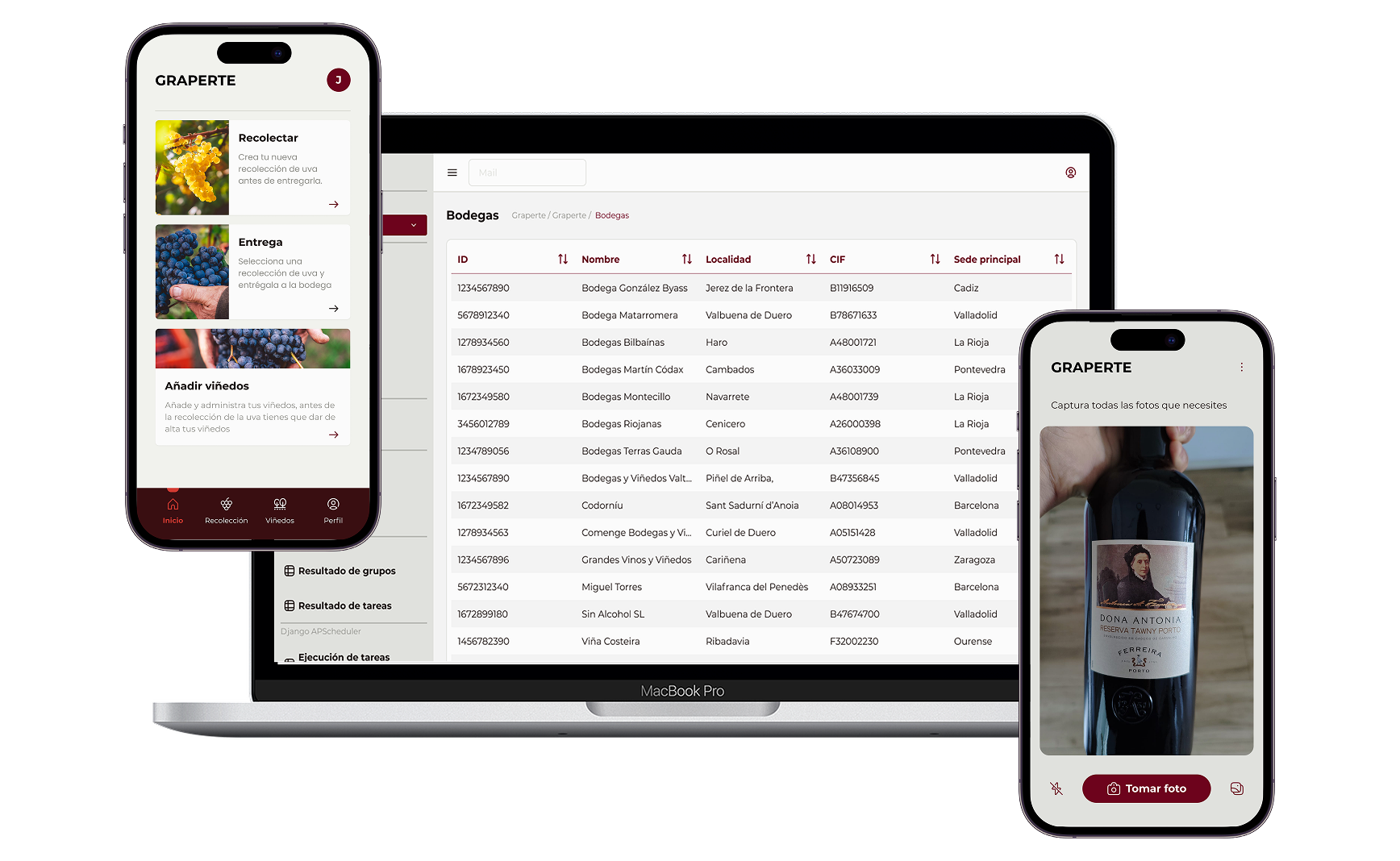
A mobile app that uses computer vision to recognize key information on a wine label from an image. Once the label is identified, consumers can track the history of a specific bottle, including information about the origin of the grapes, the production processes, and other relevant details related to the product’s journey.
App for farmers
A mobile app designed to digitize the grape harvest process from the very beginning. It enables growers to record information and documentation regarding the harvested grapes, their condition, the associated lot, and the delivery made to the winery. In this way, traceability begins at the earliest stages of the value chain, linking field operations with the rest of the production process.
Traceability Service
A web service integrated with the farmers' app and the various digital systems already in place at the wineries. Its function is to process data from diverse sources to generate evidence of wine traceability, both in the form of verifiable credentials and through tokens recorded on the blockchain, thereby reinforcing confidence in the product's origin and production history.
Applied computer vision
The solution uses computer vision to identify key information from the wine label based on a photo taken by the consumer. This feature makes it possible to recognize the specific bottle and link it to its traceability information, turning a simple action—taking a photo—into a gateway to the product’s journey. The goal is to present complex data to the end user in a way that is understandable, quick, and useful.
Verifiable credentials
The raw data generated during the process is structured as verifiable credentials, enabling the creation of digital evidence regarding the product’s origin, operations, and evolution. This approach makes it easier to issue, access, and verify specific data with greater confidence, providing added value and preparing it for scenarios where different entities need to share reliable information.
Tokenisation of events on the blockchain
The solution uses tokens recorded on the blockchain to represent specific milestones or relevant evidence within the wine value chain. This layer enables information about the production process to be linked to traceable records that are tamper-proof and can be accessed at a later date. The aim is not to introduce blockchain as a standalone element, but to use it as a trusted framework to enhance the traceability, transparency and accuracy of the product’s journey.
System integration
One of the key features of the solution is its integration with existing digital systems within the winery and with data captured in the field. The traceability service processes data from diverse sources to consolidate it into a comprehensive view of the product. This helps eliminate parallel processes, reduce duplication, and align traceability with actual operations, ensuring that the technology adapts to the existing workflow.
My role
Delivery coordination, functional definition, and traceability
My role focused on coordinating the implementation, ensuring functional deployment, and defining traceability workflows within an industrial environment involving multiple systems, data sources, and stakeholders. I worked on translating operational and technological requirements into clear workflows, helping to connect the farmers’ app, the consumer-facing interface, and the traceability web service integrated with the winery’s digital systems. The main challenge was to organize a technically complex solution—computer vision, verifiable credentials, tokenization, and blockchain—so that it could fit into real-world processes for grape harvesting, wine production, and tracking.
Results
The project made it possible to develop a more transparent and interconnected traceability solution capable of integrating information from the field, the winery, and diverse sources within a single functional framework. Defining workflows helped organize how product data was recorded, processed, and accessed, facilitating the relationship between the solution’s various components: the farmer app, visual recognition for consumers, verifiable credentials, blockchain tokens, and the traceability web service. This helped transform a complex technological proposal into a more actionable, understandable system aligned with the wine industry’s actual operations.
Learning
This project allowed me to delve deeper into how to implement emerging technologies in industrial settings where traceability depends on physical processes, distributed data, and very specific operational needs. One of the key lessons I learned was the importance of aligning the technological vision with real-world usage: it is not enough to simply incorporate blockchain, AI, or verifiable credentials if these elements do not integrate naturally into existing workflows. The project strengthened my ability to coordinate delivery, prioritize functional requirements, and translate complex technical solutions into clearer experiences and processes for different user profiles.
Let's apply traceability to real-world processes
We can discuss traceability, data integration, applied AI, or solutions that need to evolve from a technological concept into a clear, useful experience that’s closely tied to real-world operations.