Social Services Platform
Strategic definition of a multi-entity social platform with applied AI and a product vision
This project involved defining and implementing a digital platform used by multiple social organizations to manage processes related to support, guidance, training, job placement, and follow-up for people in vulnerable situations. The work combined research with real users, functional analysis, strategic UX, and exploration of opportunities for applied AI to reduce administrative burden, improve traceability, enhance data quality, and transform a complex ecosystem into a clear, scalable product proposal ready for incremental development.
UX Discovery · Applied AI · Digital Product · Functional Definition · User Research
The problem
The challenge of organizing a complex social ecosystem—with multiple profiles and processes—into an efficient, auditable, and people-centered platform.
The project is based on a platform used to manage support, guidance, training, job placement, and follow-up processes for people in vulnerable situations. The challenge was not merely to redesign a tool, but to understand how very different user profiles work, identify real friction points in their day-to-day activities, and transform fragmented processes into a clearer, more user-friendly solution ready to incorporate automation, analytics, and artificial intelligence in a way that makes operational sense. The deliverables identified the high administrative burden, the lack of traceability in follow-ups, the need to automate repetitive tasks, and the need to improve data quality as critical issues.
Administrative burden in sensitive processes
Teams that support vulnerable individuals manage complex information, follow-ups, documentation, care plans, and coordination with various stakeholders. The challenge was to reduce manual and repetitive tasks without compromising the quality of care, ensuring that the platform helped streamline the work rather than becoming an additional burden.
Lack of traceability and an integrated approach
The processes of guidance, training, placement, and follow-up generated relevant information, but it was not always easy to access, correlate, or analyze. The challenge was to build a more integrated view of each individual’s journey, improving the traceability of actions, decisions, and outcomes to facilitate more consistent, data-driven management.
Diversity of users, roles, and needs
The solution had to cater to a wide range of user profiles: technicians at social organizations, coordinators, technical offices, institutional staff, and future users with greater autonomy within the system. Each role had different objectives, digital skills, and operational needs, so the challenge was to design a flexible experience without fragmenting the product or making it harder to maintain.
The solution
Multi-entity platform design
The platform was designed to centralize the management of participants, organizations, companies, job postings, training programs, career paths, and follow-ups within a single functional ecosystem. The goal was to reduce the fragmentation of tools and provide a more consistent experience for users with different responsibilities, allowing each user to access the tasks, data, and processes relevant to their role.
UX & Functional definition
The solution was developed using user journeys, low-fidelity wireframes, user story maps, and the definition of key features. The focus was on transforming the needs identified in the research into clear, prioritized, and actionable workflows, thereby facilitating a more streamlined experience for recurring tasks such as entering information, checking itineraries, managing follow-ups, or coordinating actions among different user roles.
AI applied to support processes
The proposal included artificial intelligence solutions designed to reduce repetitive tasks, improve data quality, and support decision-making in career guidance and job placement processes. The use cases explored included conversational assistants, content generation, advanced analytics, recommendations, and support for matching profiles, needs, and opportunities—all intended to complement professional work.
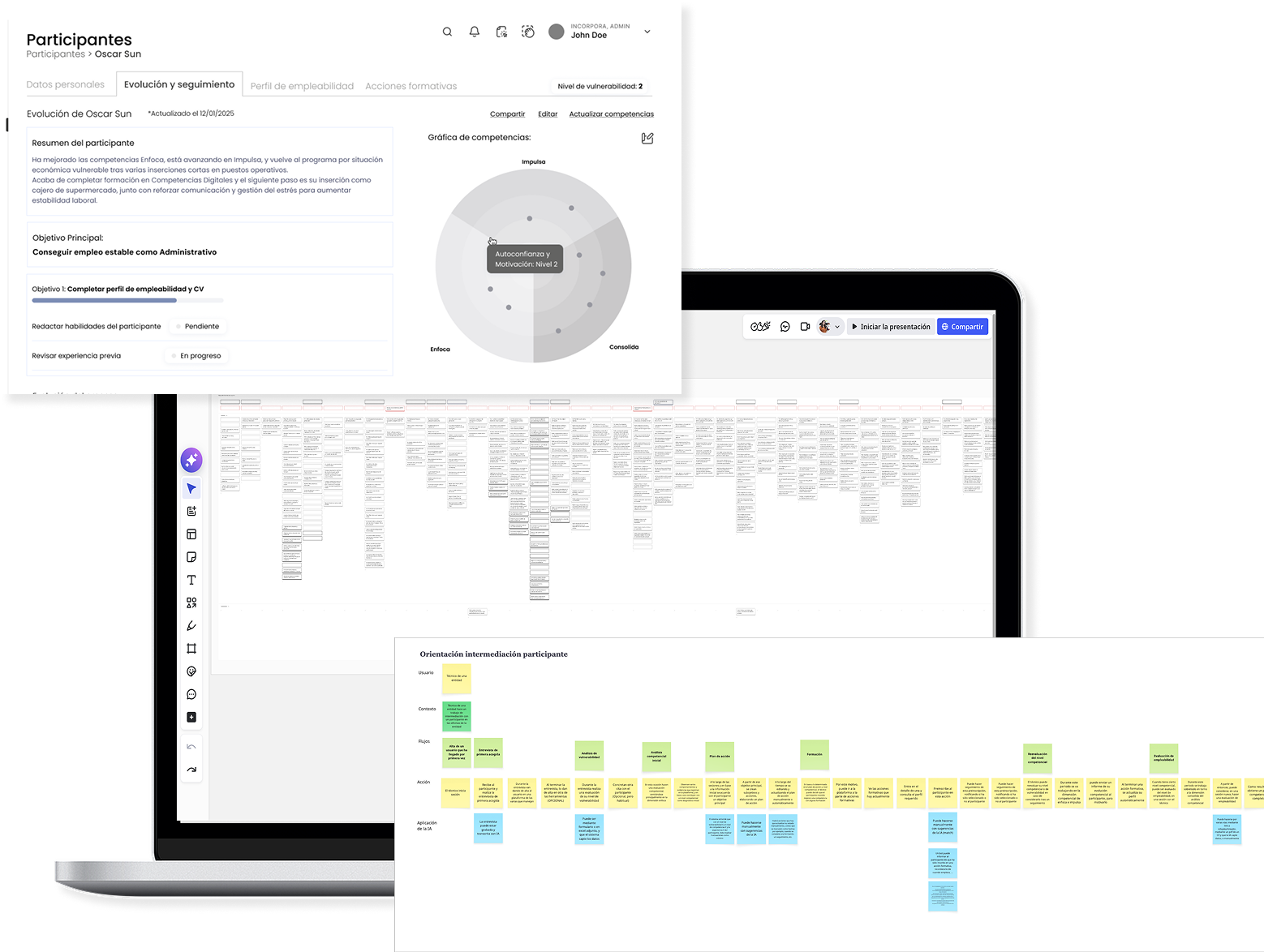
Complex ecosystem
The project began with an environment characterized by a wide variety of roles, organizations, processes, and levels of coordination, where each user had different needs, responsibilities, and ways of working. The challenge was to understand how the entire ecosystem—from direct care to coordination and oversight—functioned in order to identify dependencies, friction points, and opportunities for improvement without oversimplifying a highly complex operational reality.
Operational friction
One of the main focuses was identifying the tasks that created the greatest workload on a day-to-day basis: manual record-keeping, duplication of effort, difficulty accessing information, inefficient processes, and a lack of traceability in follow-ups or key decisions. The analysis helped us understand which issues were truly affecting team efficiency and how a new solution could reduce administrative burdens without compromising the quality of support.
AI applied with discernment
The exploration of artificial intelligence was approached from a practical perspective, linking each potential use case to real-world system needs rather than to a generic technological implementation. Opportunities related to automation, conversational assistants, recommendation systems, data analysis, content generation, and decision support were analyzed, always viewing AI as a tool to support professional judgment rather than as a replacement for human work.
Product Management
The project transformed a broad and loosely structured context into a clearer, prioritized, and actionable product strategy. Based on research, functional analysis, and the identification of opportunities, a foundation was established to guide the platform’s evolution in phases, aligning user needs, business objectives, technical feasibility, and innovation potential into a roadmap designed for incremental development.
My role
Strategic research, functional implementation, and AI applied to social products
My role focused on organizing a very broad functional ecosystem based on research with real users, process analysis, and strategic UX definition. I worked on preparing and analyzing workshops, interviews, and surveys; identifying operational friction points; mapping user journeys; and translating user needs into actionable requirements. I also participated in the implementation of applied AI opportunities, helping to assess which use cases made sense from a functional, operational, and ethical standpoint within a complex social platform.
Results
The project made it possible to transform a broad, fragmented context with multiple user profiles into a clearer, prioritized product proposal ready for incremental development. The research helped identify critical issues such as administrative burden, duplication of effort, lack of traceability, difficulty accessing information, and automation needs, while the functional analysis enabled us to translate those findings into workflows, user stories, low-fidelity wireframes, and an evolution roadmap. Furthermore, the exploration of AI helped identify opportunities for real value linked to automation, conversational assistance, recommendations, advanced analytics, and data quality improvement, avoiding the approach of treating technology as a generic layer disconnected from daily operations.
Learning
This project allowed me to delve deeper into how to approach the early stages of product definition in highly complex social environments, where institutional needs, operational processes, diverse professional profiles, and people in vulnerable situations all coexist. One of the key lessons was the importance of designing based on the reality of day-to-day work, not just the client’s strategic objectives: understanding which tasks are time-consuming, what information is lost, where duplication occurs, and which decisions require more support. It also reinforced my approach to implementing applied AI responsibly, linking each technological opportunity to a specific problem, a validated need, and a tangible improvement for users and the organization.
Bring the idea down to earth with a clear roadmap
We can discuss products, UX, user research, applied AI, or digital solutions that organize complex processes and transform them into clear, useful experiences that are ready to evolve.