AI and traceability for airport mobility
R&D project to support the development of an autonomous aircraft towing vehicle through blockchain traceability, production optimisation and digital monitoring.
The project involved the development of an autonomous airport vehicle powered by an electric motor with extended range using hydrogen, designed to optimise aircraft movement and reduce operational times on the tarmac. Within the consortium, my involvement focused on the digital aspects handled by Izertis: blockchain traceability of parts and assemblies, auditability backend, production optimisation model, functional QA, documentation, demo preparation and functional design of a monitoring panel for autonomous driving.
Autonomous mobility · Airport · Blockchain · Artificial intelligence · Traceability · Delivery
The problem
The challenge of developing and validating an autonomous mobility solution for the airport environment, combining autonomous driving, energy innovation, manufacturing traceability and production optimisation within a highly regulated context, where safety, auditability and coordination between stakeholders were critical factors.
The project tackled a complex challenge: reducing the time taken to tow aircraft using an autonomous, electric vehicle with extended range powered by hydrogen, capable of operating in controlled airport environments. However, the challenge lay not only in the physical vehicle, but in the entire ecosystem required to make it viable: supervision, validation, component traceability, production optimisation and coordination between the various members of the consortium.
As this was an R&D project, the solution had to be developed amidst technical uncertainty, safety constraints and iterative validation. This meant making a clear distinction between what had been tested in a closed-loop environment, what had been validated through simulation, and the digital layers developed to provide auditability, control and support for decision-making.
Autonomy in a critical environment
The airport environment demands very high standards of safety, coordination and operational control. Automating part of the aircraft towing process involved exploring how an autonomous vehicle could reduce unnecessary time and movement, whilst ensuring that human supervision was maintained at all times and reserving the final manoeuvres for specialist staff.
Traceability of parts and assemblies
In the event of a potential fault, defect or incident, it was essential to be able to trace which components made up each assembly, how they had been assembled, and the relationships between the parts. Blockchain traceability made it possible to explore a more auditable and less tamper-proof layer of record-keeping along the assembly line.
Production optimisation
Manufacturing an innovative vehicle involves coordinating materials, people, tasks, workstations and interdependencies between processes. The challenge lay in supporting decision-making regarding which tasks to prioritise, identifying bottlenecks and anticipating whether production deadlines were achievable or whether there was a risk of delays.
The solution
Blockchain traceability of components
A blockchain infrastructure was developed to record information on parts, components and assemblies used during the vehicle’s manufacture. This layer enabled the maintenance of an auditable history of the relationships between components, facilitating traceability along the assembly line and providing a more robust basis for analysing incidents, maintenance issues or potential defects detected during the product’s lifecycle.
Smart production optimisation
The solution incorporated a classical artificial intelligence model designed to support task planning and prioritisation within the manufacturing process. Based on information regarding available materials, human resources, dependencies between activities and production status, the system was able to recommend more efficient work sequences, helping to anticipate bottlenecks and assess the feasibility of planned deadlines.
Monitoring of autonomous driving
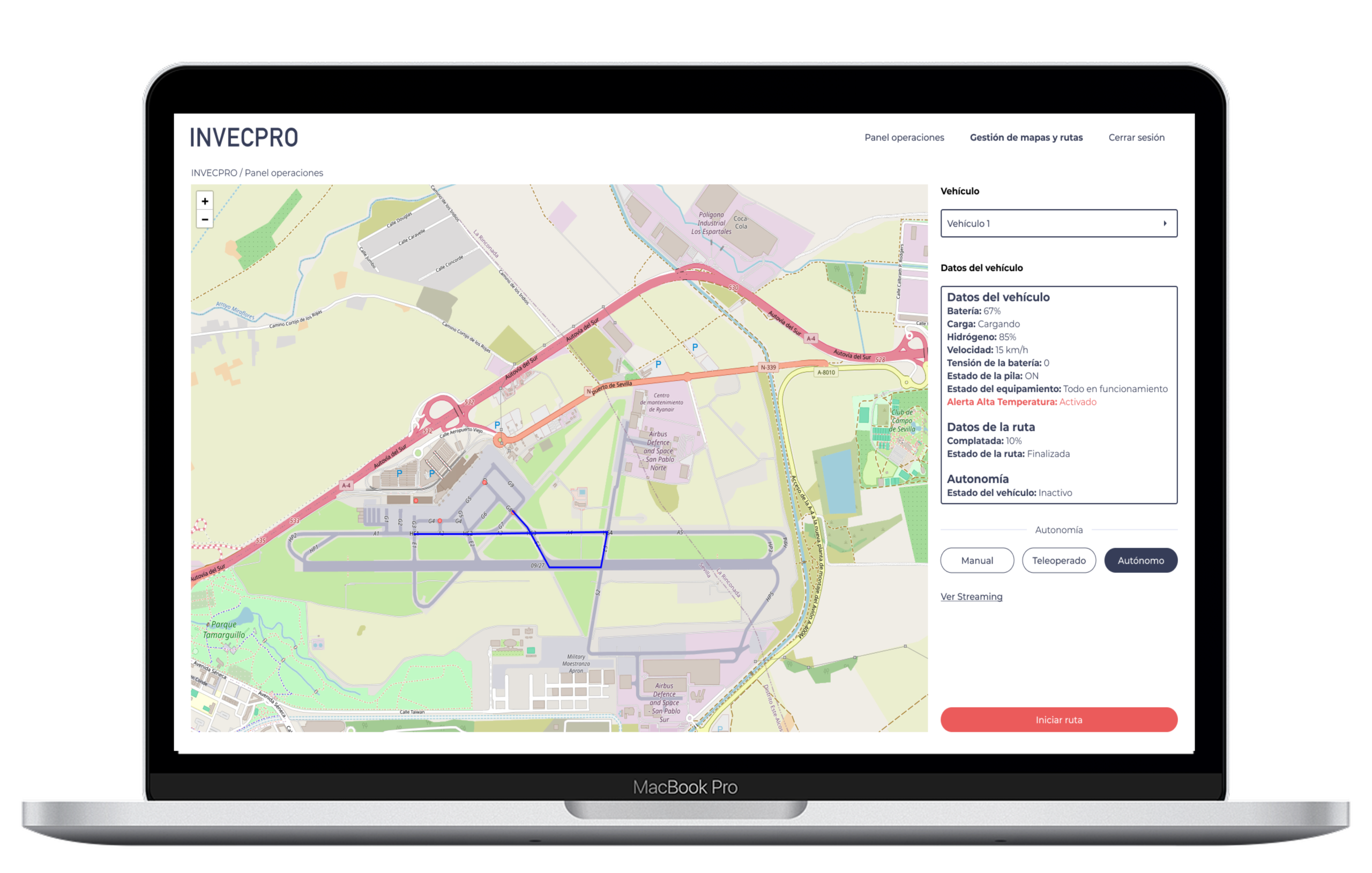
A monitoring dashboard was designed to display relevant information on the operation of the autonomous vehicle during testing and validation. The interface allowed operational data to be consolidated into a single point of reference, making it easier to track the system’s performance and supporting the monitoring of tests carried out in simulation and closed-loop environments.
Digital ecosystem for validation
The various layers developed complemented the work carried out by the other members of the consortium, providing auditability, optimisation and monitoring capabilities for a project that combined autonomous driving, hydrogen-powered electrification and operation in a highly demanding airport environment. The result was a digital ecosystem designed to support the technological validation of an innovative solution prior to its potential deployment in real-world scenarios.
Manufacturing traceability
The blockchain layer provided a way of recording critical information about the manufacturing process with greater resistance to tampering. Beyond simply storing data, the value lay in being able to reconstruct relationships between components and assemblies when it was necessary to analyse an incident, inspect a specific part or justify decisions within a complex industrial process.
AI for production optimisation
The optimisation model helped to prioritise manufacturing tasks by taking into account the availability of materials, human resources, workstations, dependencies and target dates. Rather than simply automating an isolated decision, the solution aimed to support production planning and anticipate bottlenecks, delays or unfeasible scenarios before they impacted the vehicle’s development.
Autonomous monitoring
The monitoring dashboard enabled the display of relevant information during autonomous driving tests, facilitating the functional monitoring of the vehicle in simulated and closed-circuit environments. As this was an MVP, the priority was to present operational data in a clear and useful way for validation purposes, rather than to build a visually polished interface.
Experimental validation
The project combined real-world development, simulation and testing in a controlled environment to advance the validation of a highly innovative solution. The physical vehicle was tested on a closed circuit, whilst other capabilities were evaluated using a simulator and real-world data from an airport environment, maintaining a clear distinction between what had been demonstrated, what had been simulated and what was still pending operational validation.
My role
Delivery, functional analysis and monitoring design for the MVP
My role focused on coordinating and overseeing the delivery of the digital components assigned to Izertis within the consortium, aligning functional requirements, technical progress and dependencies with other project members. I worked on functional analysis, documentation, the roadmap, preparing demos and functional QA for the developments, as well as the functional design of an MVP dashboard for monitoring autonomous driving. My role combined management, product vision and functional validation within an R&D context characterised by high technical uncertainty and multiple stakeholders.
Results
The project resulted in a tangible development within an R&D pilot, combining a physical vehicle tested on a closed circuit, simulator-based validations, the use of real-world data from the airport environment, and various digital layers focused on traceability, optimisation and monitoring. On the part undertaken by Izertis, work was carried out on a blockchain traceability backend for parts and assemblies, a production optimisation model, the functional integration of these capabilities and an MVP monitoring dashboard. Although the solution was not tested in real-world operation within an airport, it enabled progress to be made in the technical validation of the concept and allowed us to distinguish which parts had been developed, simulated or were pending validation in an operational environment.
Learning
This project reinforced what I had learnt about managing digital products and development within complex R&D projects, particularly when several members of a consortium are involved, each with different responsibilities, timelines and interests. It helped me to cope better with uncertainty, to coordinate dependencies between physical, software, AI and blockchain layers, and to maintain clear communication regarding what had been developed, what had been validated and what was still at the exploratory stage. It was also an important lesson in patience, coordination and realism when it comes to turning technological innovation into a viable use case.
Let’s talk about applied innovation
I support digital projects in highly uncertain environments, helping to clarify requirements, coordinate teams, validate solutions and turn emerging technologies into clearer, more useful and demonstrable experiences.