Functional analysis for radiology
Definición funcional y UX de un marketplace clínico para conectar clínicas y radiólogos externos
The project involved the functional and UX design of a digital radiology platform, aimed at connecting clinics with external radiologists in a context of high demand and a shortage of available professionals. The proposal explored a healthcare marketplace model to manage requests for reports, assignments, response times, second opinions and the delivery of results, whilst maintaining controlled access to clinical information for legal and privacy reasons.
Health · Radiology · Functional analysis · UX · Marketplace · Digital product
The problem
The challenge of developing a digital solution to coordinate the demand for radiology reports between clinics and external professionals, against a backdrop of a shortage of radiologists, the need for rapid response, and legal restrictions on the sharing of clinical information.
Many clinics and healthcare centres needed to process diagnostic tests within tight deadlines, but did not always have enough radiologists on staff to handle the workload. This led to a reliance on external professionals who worked with multiple organisations, with poorly standardised processes for receiving requests, accepting assignments, delivering reports or managing second opinions.
Data sharing was one of the most sensitive issues. Clinics needed to share enough information to enable the radiologist to assess the case and produce a report, but without disclosing more data than was necessary or breaching legal or privacy requirements. At the same time, the results had to be integrated into the care pathway: consultation by the doctor, communication with the patient, inclusion in the medical record, or subsequent review.
Coordination between clinics and radiologists
The system was designed to enable a clinic to post or assign report requests, manage response times, and decide whether to handle them internally or refer them to external professionals based on availability, specialism or business rules.
Secure management of clinical information
One of the main challenges was to design workflows that would enable the controlled sharing of health data, showing the radiologist only the information needed to approve or produce the report, whilst ensuring the process remained traceable.
Continuity of care
The platform was designed to cover not only the generation of the report, but also its review by the doctor, the option of a second opinion, communication with the patient, and the integration of the results into the centre’s clinical workflow.
The solution
Healthcare marketplace for radiology
The proposal outlined a clinical marketplace where clinics could manage requests for radiology reports and connect them with in-house or external radiologists based on availability, specialism, response times and business rules. The model enabled the organisation of test requests, facilitated the allocation of reports, and provided freelance radiologists with a controlled environment in which to receive requests, accept or decline them, and deliver results within defined timeframes.
Complex care pathways
The solution was not limited to the relationship between the clinic and the radiologist, but encompassed the entire care cycle: ordering or requesting a test, accepting the report, preparing and delivering it, medical review, requesting a second opinion, communicating the results to the patient, and incorporating the results into the medical record. The aim was to design a system capable of coordinating multiple stakeholders, processes and decisions within a sensitive and regulated healthcare environment.
Controlled management of clinical information
One of the key aspects of the design was to enable the exchange of sufficient information to produce the radiology report, without disclosing more data than was necessary. To this end, workflows were defined whereby each user could access the appropriate information according to their role, the stage of the process and the legal restrictions associated with clinical data.
Product base for validation
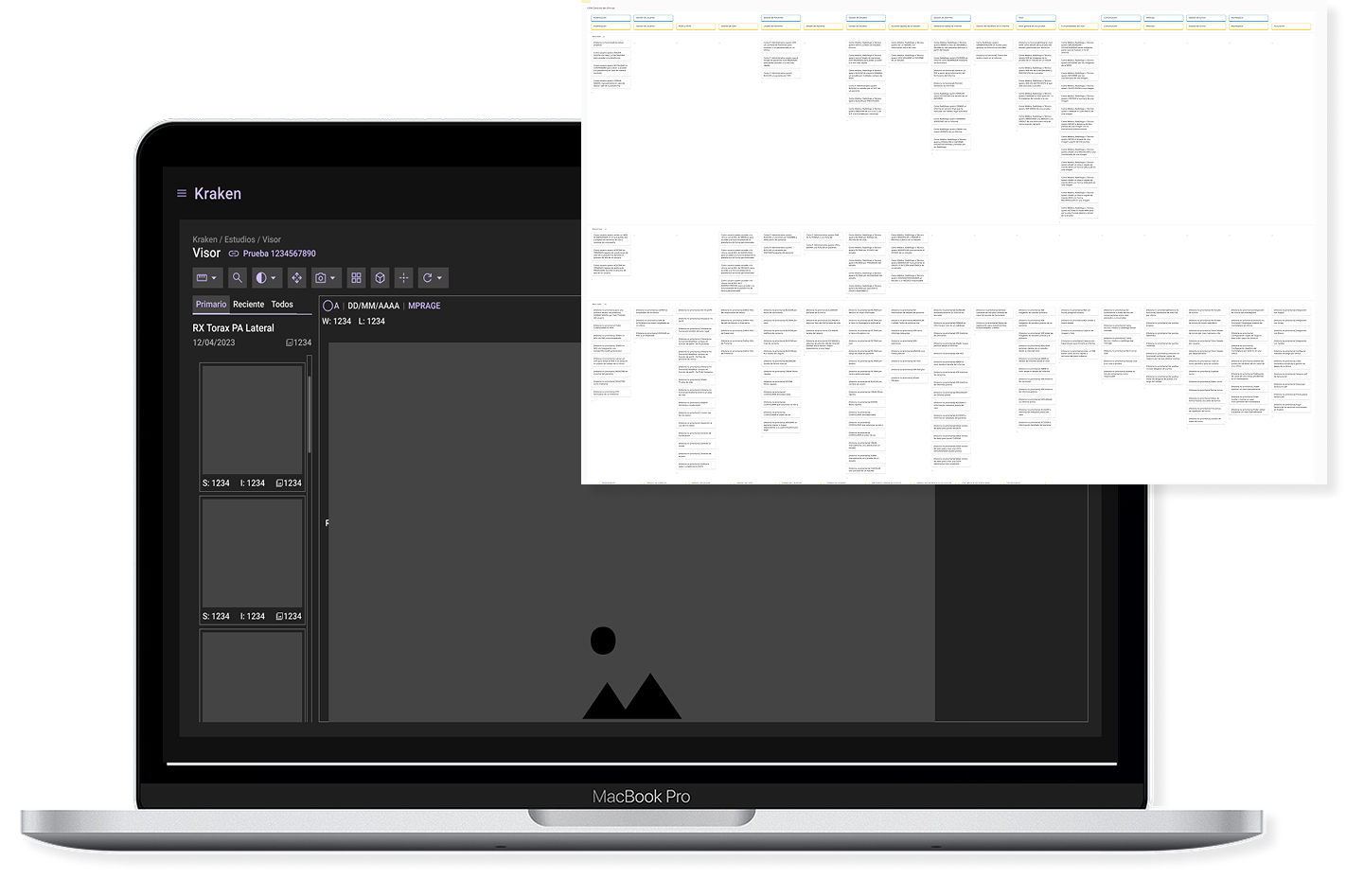
The project involved transforming a complex requirement into a structured functional proposal, complete with processes, requirements, detailed wireframes and a visual prototype. This foundation was used to assess the scope, feasibility, cost estimates and next steps before deciding on a potential development phase.
Modelling of complex flows
The functional analysis translated a healthcare process involving multiple stakeholders, rules, permissions and statuses into a clear product logic. The entire radiology request cycle was addressed, from creation or allocation through to the delivery of the report, second opinions, medical consultations and subsequent communication with the patient.
Smart automation
The proposal incorporated automation, indexing and advanced search capabilities to facilitate the management of requests, the retrieval of information and operational recommendations. The approach was based on machine learning techniques and search indexes, prior to the rise of generative AI.
My role
Functional analysis, UX and product definition
My involvement focused on the initial phase of analysis, conceptualisation and functional definition of the product. I worked on competitive benchmarking, user journeys, process mapping, user story mapping, functional requirements, estimation, documentation and the definition of workflows for the various roles involved: clinics, external radiologists and doctors.
I also developed detailed wireframes to establish the product’s logic prior to the visual design phase, paying particular attention to request management, allocation rules, response times, controlled access to clinical information and the continuity of the care process. The technical architecture and final visual design were developed by other members of the team.
Results
The project succeeded in transforming a complex business requirement into a functional product foundation, structured sufficiently to assess scope, feasibility and next steps. Although the platform was never developed, Sprint Zero produced a comprehensive definition of the model, key workflows, requirements, estimates, wireframes and a prototype, which served as supporting material for fundraising and decision-making.
Learning
This project strengthened my ability to tackle the early stages of product development in complex sectors, where no clear solution has yet been established and it is necessary to organise processes, stakeholders, legal constraints and business opportunities. It also provided valuable insight into how to design digital experiences in the healthcare sector, striking a balance between operational efficiency, the privacy of clinical data and the real needs of healthcare professionals.
Let’s talk about applied innovation
I support digital projects in highly uncertain environments, helping to clarify requirements, coordinate teams, validate solutions and turn emerging technologies into clearer, more useful and demonstrable experiences.