Clinical telemonitoring solution
Remote monitoring of patients with heart failure using predictive AI and digital clinical follow-up
This was a European innovation project initiated by the public sector to develop and validate advanced technological solutions in a real-world clinical setting. Its aim was to improve the quality of life of patients with chronic heart failure through remote monitoring, continuous clinical follow-up and predictive models based on artificial intelligence. The initiative was carried out within the framework of an international consortium and enabled the solution to be tested in three hospital pilot schemes, bringing prevention, clinical support and data-driven decision-making closer to clinical practice.
HealthTech · Predictive AI · Strategic UX · Digital Product · Delivery · European R&D
The problem
The challenge was to transform care for older adults into a seamless, coordinated, and remote experience, without adding complexity for those who need clarity the most.
A project where the key was not just to create a platform, but to design a solution capable of improving the monitoring of people with chronic conditions, facilitating care coordination, and reducing friction for users with limited digital literacy. The challenge was to integrate the technology into real-world health and care processes without adding further complexity.
Ongoing monitoring of vulnerable patients
Older adults and those requiring ongoing care need support that goes beyond occasional check-ins. The challenge was to provide more consistent, proactive monitoring that is attuned to the patient’s daily reality, enabling the detection of significant changes without relying solely on in-person visits or isolated contacts.
Coordination between healthcare, caregiving & tech
The context required coordinating clinical, operational, and technological needs among the consortium, several companies, and three pilot hospitals. Beyond simply designing a tool, the solution had to facilitate collaboration among healthcare, technical, and management teams, helping to organize information and maintain clarity in an already fragmented healthcare environment.
Usability for users with limited digital literacy
One of the main challenges was to design an accessible, clear, and user-friendly experience for older adults and caregivers, without compromising its usefulness for professionals. The interface had to reduce friction, simplify tasks, and inspire confidence, while taking into account real barriers related to age, context, comprehension, and technological familiarity.
The solution
Patient App
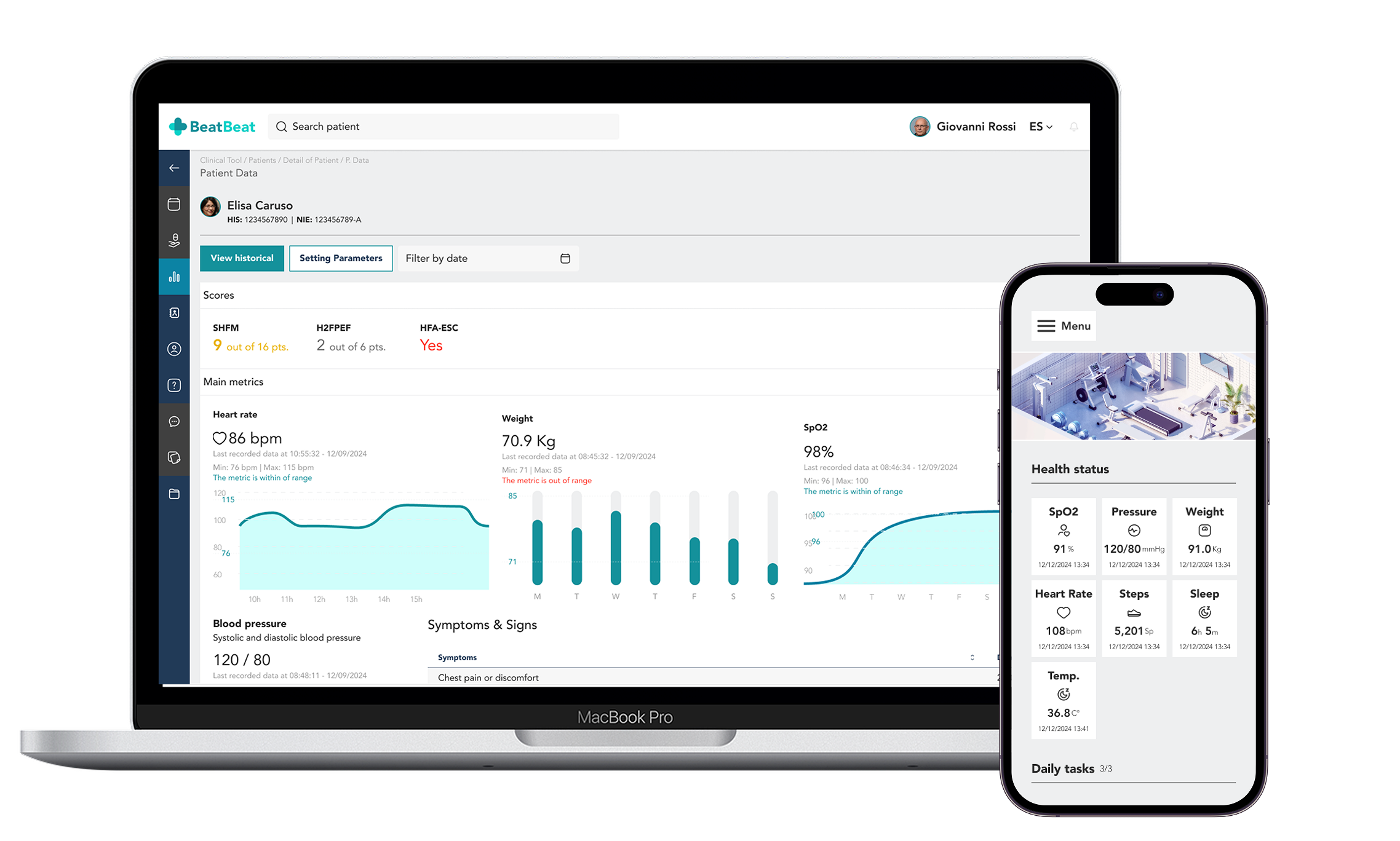
A mobile app that allows patients to record relevant information about their health, view daily tasks, and maintain a more consistent connection with the clinical team. The user experience is streamlined to make it accessible, automatically collecting data through a connection with IoT monitoring devices.
Clinical Tool
A web-based tool for clinical staff that collects and processes patient information. This app allows users to track a patient’s progress and detect early signs of deterioration. The focus was on providing a quick overview of the patient’s clinical status and supporting care decisions in a real-world work environment.
Clinical Dashboards
Dashboards designed for case managers that provide an aggregated view of key indicators, trends, and patterns, helping to interpret the information generated by the system. Their purpose is to transform clinical data into actionable insights for monitoring, analyzing, and continuously improving care.
Predictive analytics models
The solution incorporated artificial intelligence models designed to detect anomalies in a patient’s condition at an early stage. Using data from the patient app, the system analyzed individual patterns of physiological behavior to identify significant deviations from each patient’s baseline. The goal is to support more preventive care by facilitating the detection of sudden or sustained changes that could signal a potential clinical risk.
The Major Challenge of Adherence
One of the key aspects of this project has been ensuring that the solution integrates naturally into the patient’s daily routine, without causing resistance, abandonment, or a feeling of being overwhelmed. To achieve this, the design must be clear, intuitive, and useful from the very first use, especially for users with less technological familiarity. The challenge has been to simplify the interaction without losing clinical value, ensuring that remote monitoring is perceived as real support rather than an additional task that is difficult to maintain.
Digital Identity in the Healthcare Sector
The solution also explores the use of self-sovereign digital identity in the healthcare setting, investigating how verifiable credentials could facilitate more secure, traceable, and controlled access to relevant patient clinical information. In such a sensitive context, it is essential to analyze cryptographic mechanisms that strengthen trust among authorized entities, protect privacy, and enable healthcare portability and interoperability.
Remote telemonitoring
The system allows for the collection and review of patient information outside the hospital setting, enabling more continuous monitoring that is better integrated into the patient’s daily life. This remote monitoring helps reduce reliance on one-off check-ins, provides a more comprehensive view of the patient’s progress, and makes it easier for the clinical team to detect significant changes within a broader context before they escalate into more complex situations.
My role
Functional definition, strategic UX, and delivery in a complex clinical setting
My role evolved from UX/UI and functional definition to functional support and coordination during the final stages of delivery. I worked on the functional implementation of the solution, workflow definition, end-to-end UX, wireframes, UI design, clinical journeys, dashboards, and the functional backlog, as well as workshops, functional validation, QA, development support, and clinical demos. Although I inherited an initial discovery phase, during the process it was necessary to redefine much of the functional logic to adapt it to real clinical needs and different hospital contexts. I also participated in end-to-end validation with hospitals, support during pilot phases, functional review of implementation, and final project coordination following several internal changes within the team.
Results
The project validated a functional remote monitoring solution with real patients, combining operational clinical dashboards, wearable integration, predictive alerts, and digital care workflows designed for continuous monitoring and early detection. The platform was piloted in various European hospital settings and successfully demonstrated the feasibility of applying predictive AI in healthcare within real clinical processes, while also incorporating a shared patient journey and international clinical validation. The project subsequently progressed toward CE marking and yielded key insights regarding adherence, assisted onboarding, continuity of use, data quality, and the sustainability of digital experiences for vulnerable patients.
Learning
This was one of the projects where I gained the deepest insight into healthtech, complex products, clinical UX, design for vulnerable patients, AI-driven systems and multidisciplinary coordination within European innovation environments. As well as being involved in the functional definition and delivery of a highly complex solution, the project gave me a first-hand understanding of how the quality of the user experience directly influences the clinical and technological value of the product. Above all, it taught me that AI only delivers real value when the experience, processes and data quality are sufficiently well designed to sustain it over time.
Let's tackle a complex challenge
We can discuss products, UX, digital health, applied AI, or complex solutions that need to evolve from an idea into a clear, actionable plan focused on real-world application.